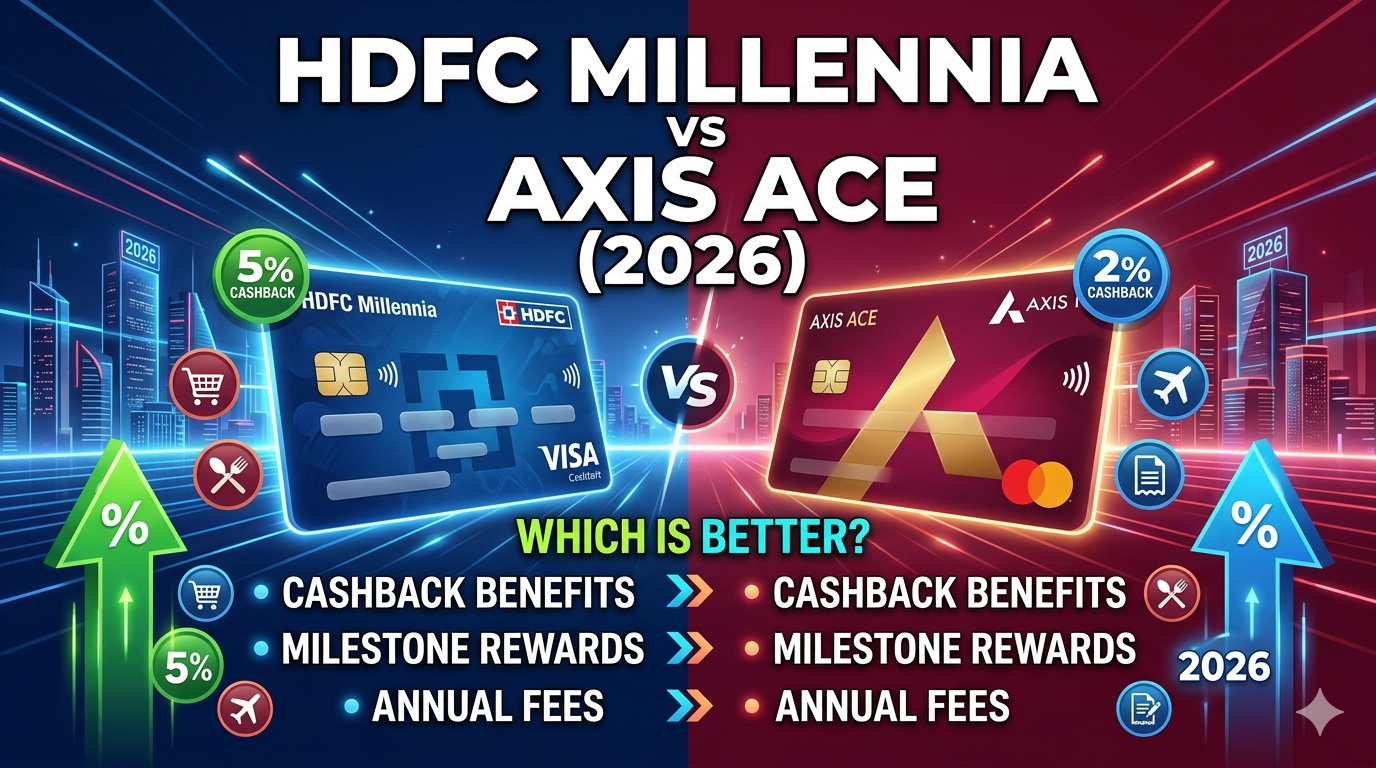
HDFC Bank Millennia and Axis Bank ACE are two of the most popular entry-level and mid-mass “cashback-style” credit cards in India. Both are aimed at people who do a lot of digital spending — but they reward different kinds of online habits.
This article compares HDFC Bank Millennia Credit Card and Axis Bank ACE Credit Card using the same published fees, earn rules, and lounge details shown on each CardCheck card page (sourced from bank programme wording and the MITC). Figures below are current as of 2026-04-23; banks can change benefits, so double-check the live offer before you apply.
Compare on CardCheck puts both products side by side. Rewards calculator helps if you want to type in your own monthly numbers.
Cards in this comparison
Compare now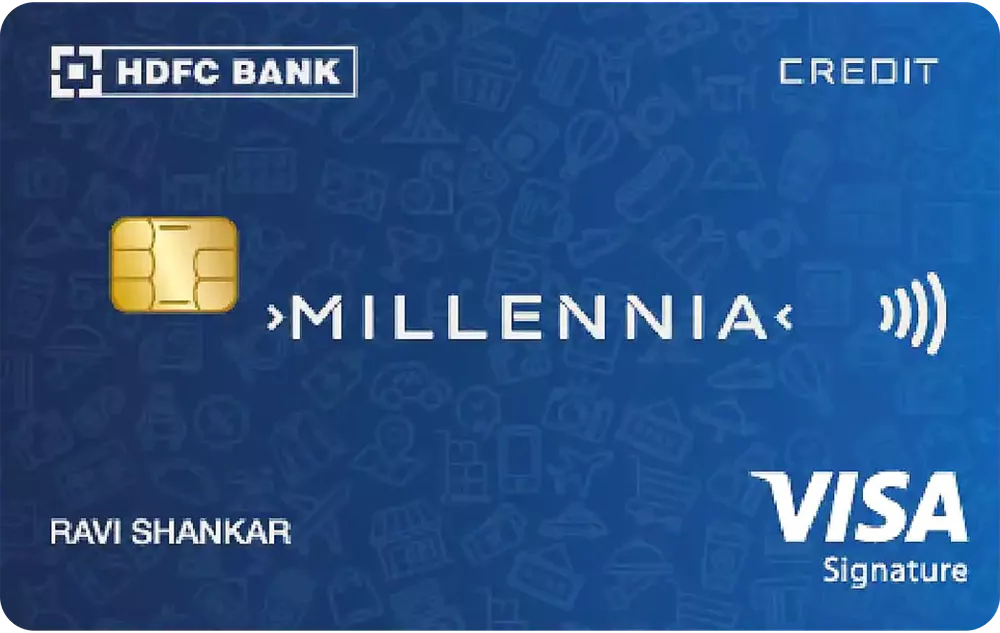

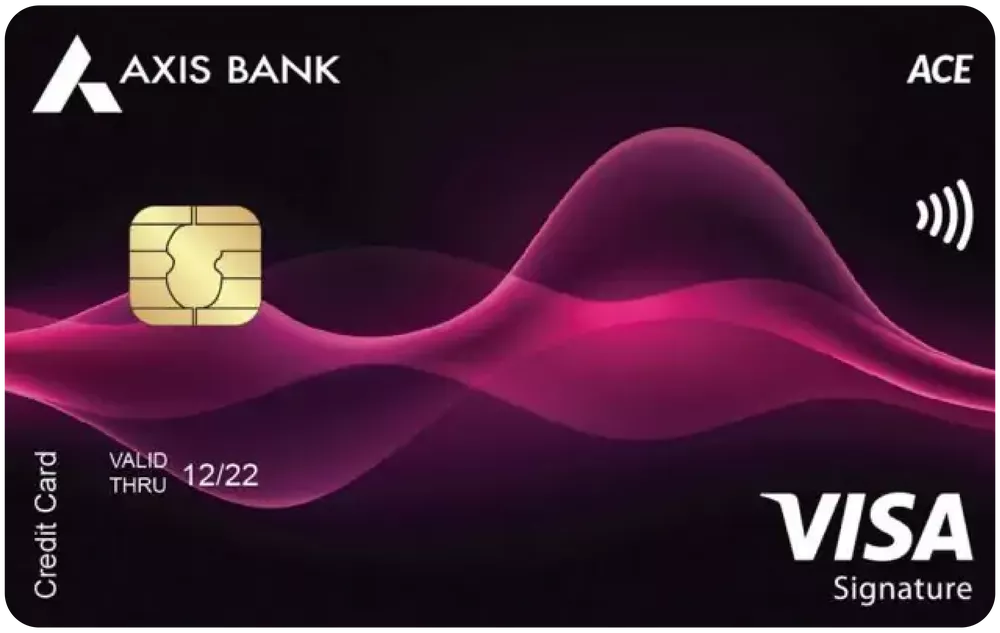

At a glance: fees, waiver, and basics
| Topic | HDFC Bank Millennia Credit Card | Axis Bank ACE Credit Card |
|---|---|---|
| Card page | HDFC Bank Millennia Credit Card | Axis Bank ACE Credit Card |
| One-time (joining) fee | ₹1,000 + taxes | ₹499 + taxes |
| Yearly (renewal) fee | ₹1,000 + taxes | ₹499 + taxes |
| Yearly fee waiver (spend target) | ₹1,00,000 in a year | ₹2,00,000 in a year |
| Interest rate (published) | about 42% p.a. | about 52.86% p.a. |
| Grace period (typical) | up to 50 days from statement date, when you pay in full | not listed the same way on ACE; check Axis MITC |
| Extra charge on foreign spend | 3.5% | 3.5% |
| Stated minimum income (where published) | ₹35,000 / month | ₹15,000 / month |
| Stated CIBIL floor (where published) | 720 | 750 |
| Typical age | 21–60 | 18–70 |
GST applies on top of any fee that says “plus taxes.” Approval and credit limit are always at the bank’s discretion — these income and score numbers are public “starting points,” not promises.
How you earn: shopping apps vs Google Pay and “everything else”
HDFC Bank Millennia Credit Card is built for listed shopping and lifestyle apps at 5% on spends such as Amazon, Flipkart, Myntra, Swiggy, Zomato, Uber, BookMyShow, Cult.fit, Sony LIV, and Tata CLiQ, with 1% on all other eligible retail spends, per the bank’s summary we show on the card page. Cashback is added each quarter as CashPoints (redeemable on the lines HDFC sets out in the live programme, typically treated as about ₹1 per point for statement / catalogue style use). If your life is mostly e-commerce, food delivery, and ride-hailing, that 5% lane is the reason people talk about Millennia.
Axis Bank ACE Credit Card is built differently: 5% on Google Pay bill payments, DTH, and recharges, with that bucket capped at ₹500 per month; 4% on food delivery, grocery delivery, cabs, and selected OTT (Swiggy, Zomato, BigBasket, Ola, Hotstar, Zee5 — see Axis’s current list on the card page); and 1.5% on all other retail spends, with no separate monthly cap on that 1.5% lane in the published summary. A ₹500 welcome-style cashback is described for the first eligible transaction in the first 30 days (Axis terms apply).
Neither card is “wins on every bill.” Millennia does not pay 5% on generic “online” if the merchant is not in HDFC’s partner set; ACE does not pay 5% on utility unless you use Google Pay the way the programme requires. Exclusions in both programmes include things like fuel, rent, wallet loads, and EMI in the summaries we show — so real-world return depends on how your card swipes are coded.
Short version: if you live on Amazon/Flipkart/Swiggy-style apps, look hard at Millennia; if you live on Google Pay bills, food apps, cabs, and a lot of “rest of day” swipes, ACE is often the simpler story.
Lounges, fuel, and everyday perks
Domestic airport lounges (published):
- Millennia: 2 complimentary domestic airport visits per quarter (via DreamFolks, as listed on the Millennia page).
- ACE: 1 complimentary domestic airport visit per quarter (via DreamFolks, as listed on the ACE page).
Millennia gives you twice the domestic run-rate if you use every quarter; ACE is leaner: one visit per quarter. Neither product in the published descriptions we track includes international lounge membership — these are not travel-metal cards.
Both list a 1% fuel surcharge refund in the right bill range. That's not the same as earning cashback on fuel; programmes usually exclude or zero out reward/cashback on fuel purchases, so read the “no rewards on fuel” lines in the MITC for each product.
ACE is offered as a UPI-linked Visa in the product notes; Millennia is available on Visa or Mastercard depending on variant. That affects how you pay in apps more than the headline reward rate.
Who should pick which in 2026?
Pick HDFC Bank Millennia Credit Card if: your big spends are on the partner shopping and entertainment list (Amazon, Flipkart, Swiggy, Zomato, etc.); you are fine with quarterly cashback as CashPoints; you want more domestic lounge visits (two per quarter) at a ₹1,000 fee with a ₹1 lakh path to a waiver (plus taxes). The higher published minimum income (₹35,000/month) usually lines up with salaried professionals with steadier pay slips.
Pick Axis Bank ACE Credit Card if: you want simpler, mostly monthly cashback in rupees, run a lot of household and mobile bills through Google Pay, and like 4% on everyday delivery and cabs, plus a strong 1.5% floor on other spends; a ₹499 fee with a ₹2 lakh annual waiver target; and you meet Axis’s published bar (₹15,000/month minimum income, 750 minimum CIBIL in the listing — approval is still at the bank’s discretion). ACE is often the go-to for people who want “I pay; I get cashback this month” without points maths.
Still tied? Open both card pages, scroll to the exclusion bullets, and see which one punishes the way you actually spend. Then plug your numbers into the calculator or the compare tool so you are not comparing headline percentages in a vacuum.
Disclosure
CardCheck is a comparison and education site, not a bank. We don't set fees or approve applications. The figures here come from the product summaries we maintain for HDFC Millennia and Axis ACE as of the snapshot date above; always check HDFC Bank and Axis Bank for the current offer, MITC, and KFS before applying.
Banks can change features; if you see a mismatch, the issuer’s page wins.
FAQ
- Is HDFC Millennia or Axis ACE better for Amazon?
Millennia lists 5% on Amazon in its partner set (subject to programme rules). ACE does not use a 5% Amazon category in the same way — it leans on Google Pay for utilities, 4% on the listed food and ride apps, and 1.5% on other spend. If Amazon is your biggest line item, Millennia is usually the one to compare first.
- Why is Axis ACE’s “5%” often smaller than 5% of my total bill
The 5% path on ACE is for Google Pay utility and recharge, and Axis caps that category at ₹500 per month in the published benefit list. The rest of your spend is at 4% or 1.5% depending on the merchant category, not 5% on everything.
- Does Millennia give 5% on every online purchase?
No. The 5% rate applies to eligible spend on the named partners in HDFC’s list. If the merchant is not in that set, you typically get 1% on other retail, again subject to exclusion categories like fuel, rent, wallet load, and EMI in the published terms.
- Which has the lower total cost of ownership?
Millennia charges ₹1,000 a year (plus taxes) with a ₹1 lakh waiver target. ACE is ₹499 a year (plus taxes) with a ₹2 lakh waiver. Which is cheaper in practice depends on whether you actually clear the spend needed for a waiver, plus how much cashback you keep after each card’s excluded categories.