RuPay credit cards that support UPI let you pay at many shop QR codes straight from your credit limit — when your bank and UPI app support credit-on-UPI. NPCI explains the RuPay network at a high level; your bank’s MITC still decides what counts as an eligible spend, caps, and exclusions.
On this site we currently compare seven RuPay credit cards (spring 2026 refresh). Each is marketed with UPI payment support — but none of the published benefit summaries promise one flat “best rate on absolutely every QR code.” Cashback or points, monthly caps, and which shops qualify still follow each issuer’s fee and reward schedule.
The table below uses the same fee and reward wording you see on each card’s page here, with links so you can jump to fees, key benefits, and the bank’s apply flow in one place.
Cards in this comparison
Compare now



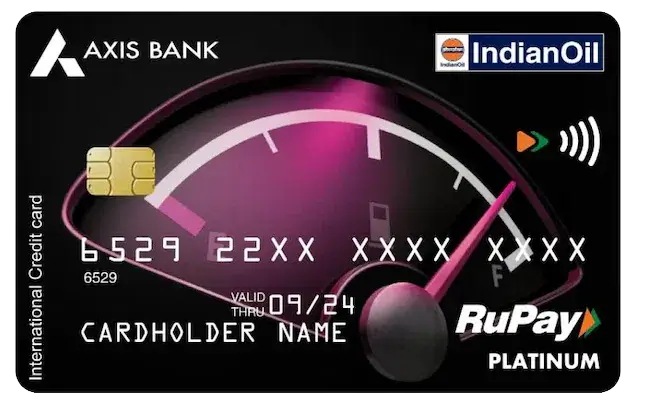

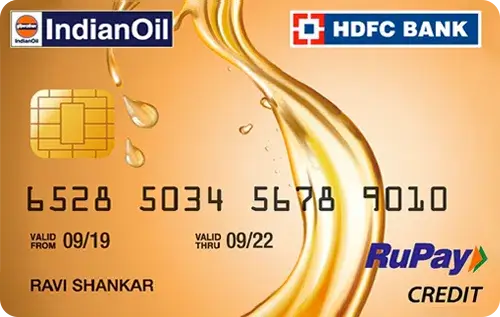
Seven RuPay credit cards compared here (each supports UPI)
| Card | Joining / annual fee (as shown on the card page) | What the published benefits say about UPI / QR pays |
|---|---|---|
| HDFC Bank UPI RuPay Credit Card | ₹99 / ₹99 (waived on ₹25,000 annual spend) | 3% CashBack on utility bills (electricity, water, gas); 1% CashBack on all other eligible UPI-linked spends; pay by scanning UPI QR codes with HDFC UPI on credit. |
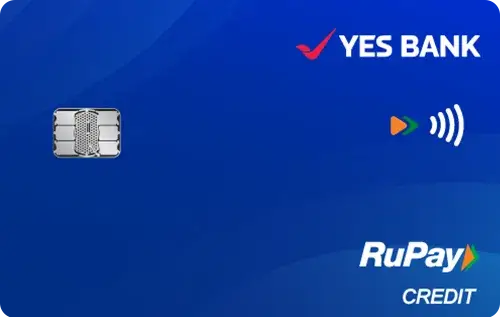
| YES Bank RuPay Credit Card | ₹0 / ₹0 | UPI-linked — use the card on PhonePe, Google Pay, BHIM; 1% cashback on eligible retail purchases. |
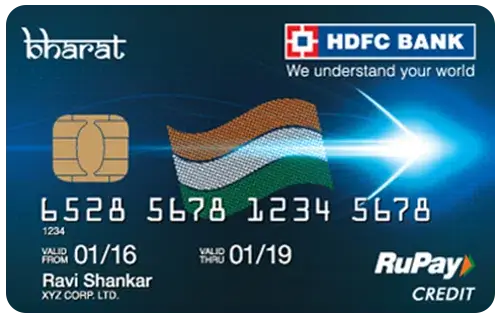
| HDFC Bank Bharat Credit Card | ₹500 / ₹500 (waived on ₹50,000 spend) | 5% CashBack on fuel, groceries, bill payments, and government payments; RuPay with UPI payment capability. |
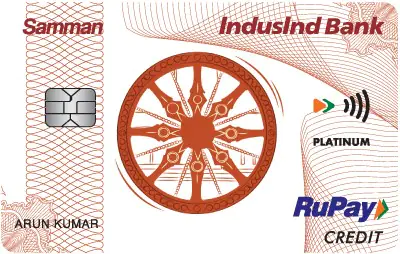
| IndusInd Bank Samman RuPay Credit Card | ₹0 / ₹0 | UPI-linked — pay with credit through PhonePe, Google Pay, and similar apps; RuPay reward points on eligible spends. |
| Indian Oil Axis Bank Credit Card | ₹500 / ₹500 (waived on ₹50,000) | 4% value back on IndianOil fuel as EDGE points; 1% on other retail; RuPay card supports UPI per Axis’s description. |
| IndianOil HDFC Bank Credit Card | ₹500 / ₹500 (waived on ₹50,000) | 5% fuel points on IndianOil fuel; RuPay with UPI payment capability. |
| Indian Oil Axis Bank Premium Credit Card | ₹1,000 / ₹1,000 (waived on ₹1 lakh) | 4% on IndianOil fuel; 2% on groceries; 1% on other spends; 100% fuel surcharge waiver at IOCL; 1 complimentary domestic airport lounge visit per quarter (DreamFolks) on the published benefits. |
Figures in the table match the fee blocks and key benefits on each linked page. For shop-level earn (for example whether your kirana codes as “retail” or “fuel”), rely on the bank’s MITC — it beats any short summary for edge cases.
Which card treats “everyday UPI QR” spend best?
- Broad UPI retail (not just utilities): HDFC Bank UPI RuPay is the only card in the table whose published wording adds 1% CashBack on all other eligible UPI-linked spends after the 3% utility bucket — “eligible” still follows the HDFC MITC.
- Simple flat cashback with no annual fee: YES Bank RuPay advertises 1% cashback on eligible retail and ₹0 joining / ₹0 annual fees — a practical pick for mixed everyday QR spends if you stay inside the bank’s exclusions.
- Bills, government payments, or grocery-heavy UPI: HDFC Bharat highlights 5% on fuel, groceries, bill payments, and government spends — strong when your QR volume is those buckets rather than random shops.
- Mostly fuel at IndianOil pumps: Axis IOCL or HDFC IndianOil — about 4–5% style value on IndianOil fuel in the published lines, with 1% on other retail on the Axis card.
Official references: NPCI’s RuPay overview explains the network; Axis Bank’s credit-card MITC PDF is Axis’s consolidated disclosure for fees and rewards.
Fees and waiver thresholds at a glance
- Lowest headline fee: HDFC UPI RuPay — ₹99 joining and ₹99 annual, with the published ₹25,000 annual spend waiver.
- Lifetime free: YES RuPay and IndusInd Samman RuPay list ₹0 joining and ₹0 annual fees on their pages.
- ₹500 / ₹500 tier: HDFC Bharat, Axis IOCL, HDFC IndianOil — each shows a ₹50,000 annual spend waiver in the fee summary unless noted otherwise on the page.
- Premium IOCL: Axis IOCL Premium — ₹1,000 / ₹1,000 with waiver on ₹1 lakh annual spend per the published schedule.
Plug your own spend into the Rewards Calculator — whether the annual fee is effectively ₹0 for you usually comes down to waiver maths, not the headline number alone.
What “reward every QR scan” does not mean
Banks almost always exclude wallet top-ups, EMI, rent, cash withdrawal, and certain merchant types from accelerated cashback. Paying through UPI does not automatically bypass those rules.
Credit-on-UPI also depends on whether your bank and your UPI app have switched on the feature for your card. Where YES Bank and IndusInd mention PhonePe, Google Pay, or BHIM, treat that as marketing guidance — double-check inside the app before you rely on it.
If something looks unclear, open the MITC PDF from the issuer’s website and search for UPI, digital, merchant, and cashback — that document is the final word for grey-area spends.
FAQ
- How many RuPay credit cards for UPI are compared on this site?
Seven RuPay credit cards are listed in the comparison above, and each bank markets UPI payment support on those products. Issuers add or retire cards over time — open the card directory and pick RuPay in the filters to see the current lineup.
- Which RuPay card pays cashback on everyday UPI QR spends?
HDFC Bank UPI RuPay Credit Card publishes 1% CashBack on all other eligible UPI-linked spends after a 3% cashback bucket on utilities. YES Bank RuPay advertises 1% cashback on eligible retail purchases together with UPI linkage. Always read the HDFC and YES MITCs for exclusions and caps.
- Do I earn the headline fuel rate when I scan a random kirana QR?
Usually no. Cards such as Axis IOCL and HDFC IndianOil advertise high earn on IndianOil or fuel categories. A generic merchant QR will typically fall into the lower “other retail” rate unless the MITC maps that merchant to a qualifying category.
- Where should I verify UPI credit rules?
Start with your issuer’s MITC and Card Member Agreement, then the bank’s mobile-banking FAQs for RuPay credit on UPI. NPCI’s public RuPay pages explain network-level positioning — not your personal earn rate.