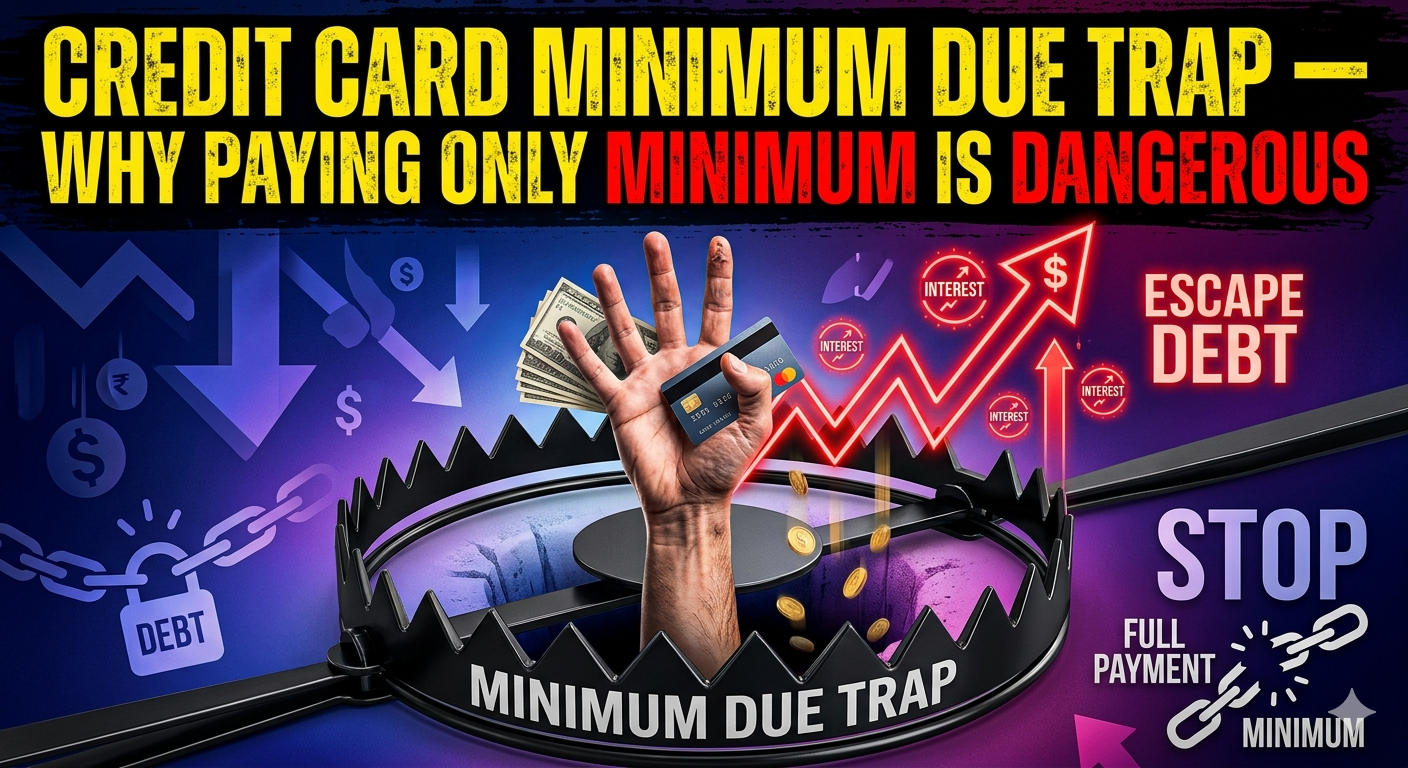
On your bill you see Minimum Amount Due (MAD) — the smallest payment the bank will accept this month without treating you as late. It feels manageable.
What it does not do is wipe the rest off: the unpaid part usually stays on the card, and the bank may add interest every month until that balance is cleared.
Below we use Reserve Bank of India rules plus printed numbers from HDFC Bank and SBI Card (their standard terms booklet, called MITC — PDF links at the bottom). Same facts, simpler story. Your bank’s latest booklet and SMS beat any article.
Cards in this comparison
Compare now


What RBI tells banks to put on your bill
In March 2024, RBI updated the rules for credit-card bills. Banks must print a clear warning: if you pay only the minimum every month, repayment can take many months or years, and you pay extra interest on what you still owe.
They must also say clearly: if any part of last month’s bill is still unpaid, you often lose the interest-free period on new purchases (check your booklet for the exact words).
RBI also states that interest should be charged only on what you actually still owe after your payments, refunds, and reversed charges are applied — not on money you already paid back.
“Minimum due” is not one rule for all banks
HDFC Bank’s terms PDF says minimum due is 5% of the total bill (Total Amount Due). Their example rounds ₹1,503.50 up to ₹1,510.
SBI Card’s terms PDF uses a different recipe: add all of certain fees and taxes, then 2% of what is left, and so on. One printed line shows Minimum Amount Due ₹710 (for example ₹90 tax + ₹500 fee + 2% of ₹6,000 spend).
So do not assume “always about 5%.” Open your bank’s booklet or your SMS / statement for the formula that applies to you.
How steep can the interest get? (real bands from the same PDFs)
HDFC lists many regular cards at about 3.6% per month, which their table shows as 43.2% per year. Some premium lines (e.g. Infinia / Diners in the same file) show 1.99% per month (`23.88%` per year).
SBI Card states up to 3.75% per month (`45%` per year) when you do not pay the full bill, and mentions a small ₹25 minimum interest in some cases (plus GST as applicable). Rates can change — the PDF is the reference.
These are samples from the banks’ own tables; your card may sit on a different row.
Why only paying “minimum” makes debt die slowly
HDFC walks through a full example in the PDF: several small balances run at the same time; in that sample the interest part alone comes to ₹628.47, and GST on fees and interest adds ₹257.12. It is there to show how fast charges add up — not a prediction of your next bill.
SBI adds a simple story next to RBI’s warning: on ₹10,000 charged, if you keep paying only the minimum (and at least ₹200 where that rule applies), clearing it can take about 52 months in their illustration.
Your real timeline depends on new spends, EMIs, rate changes, and refunds — but the point is the same: minimum payments mostly feed interest; the main amount falls slowly.
Practical steps when cash is tight
- Pay the full bill (Total Amount Due) whenever you can — even a little above the minimum helps more than it looks.
- If you have more than one card, put extra money on the one charging the highest monthly interest first.
- Pause non-essential new spending on a card until the old balance shrinks.
- On most cards the bank takes fees and interest before principal — read the allocation order in your booklet.
- Browse cards on CardCheck to compare fees before you apply; hardship plans are something only your bank can approve.
Where these facts come from
- RBI — March 2024 circular — wording banks must show; how interest is applied.
- RBI consumer FAQs — Credit cards — background from the regulator.
- HDFC Bank — Credit card terms (MITC) PDF — MAD 5% example; interest examples including ₹628.47.
- SBI Card — Terms PDF (English) — MAD with 2% on balance; `3.75%` per month / `45%` per year line; ₹10,000 / ~52 months story.
Please note
This article is general education, not personalised advice. Figures are taken from RBI and issuer PDFs reviewed for this piece — your live statement and the bank’s latest terms always win if something differs.
FAQ
- Is minimum due always 5% like HDFC says?
No. HDFC’s booklet says 5% of total bill. SBI’s booklet mixes fees plus 2% of the rest. Other banks use their own rules — read yours.
- Will my next bill show ₹628.47 interest like HDFC’s example?
Not necessarily. That number is a worked example inside HDFC’s PDF to show how interest is calculated. Your bill depends on your spends, dates, EMIs, and the rate on your card.
- Can reward points cancel out the interest?
Usually no. Interest on unpaid balance is often much larger in rupees than what you earn back in points or cashback. Pay the full bill when you can.
- If the bank does not fix my complaint, what can I do?
Use the bank’s complaint / nodal process first.
If you are still stuck, RBI runs an Integrated Ombudsman scheme — details on rbi.org.in. Keep copies of statements and emails.