
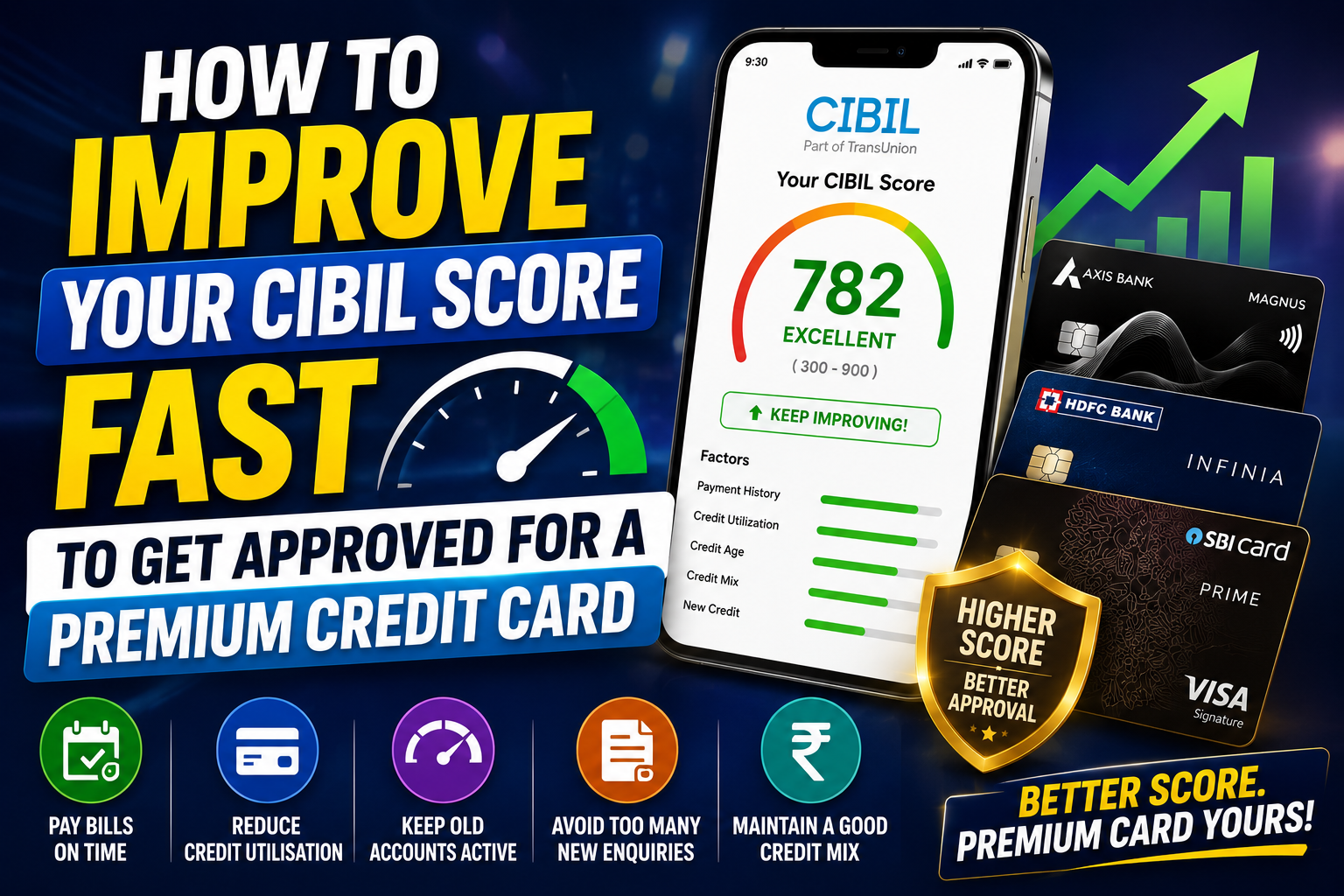
Premium cards — HDFC Infinia, Axis Magnus, SBI PRIME-class products — are not sold on charisma alone. Banks want a clean bureau file, stable income, and headroom before they hand you a ₹10,000+ annual fee line.
“Fast” does not mean overnight magic. It means attacking the levers CIBIL itself highlights — payment history, utilisation, account age, credit mix, and new enquiries — while you stop doing the things that sink applications (stacked hard pulls, maxed cards, ignored overdue marks).
Start with a free CIBIL pull (how-to guide), then use the 90-day plan below before you aim at a premium invite. Facts trace to TransUnion CIBIL’s explainer and RBI credit-information FAQs — not aggregator “score repair” blogs.
Cards in this comparison (5)


Infinia Metal Credit Card
Travel and lifestyle benefits


Magnus Credit Card
Travel & Lifestyle
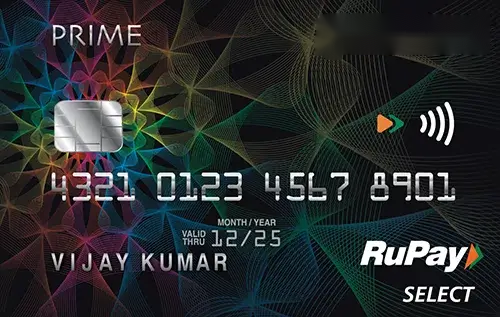

SBI Card Prime
Dining and grocery rewards

Regalia Gold Credit Card
Travel rewards
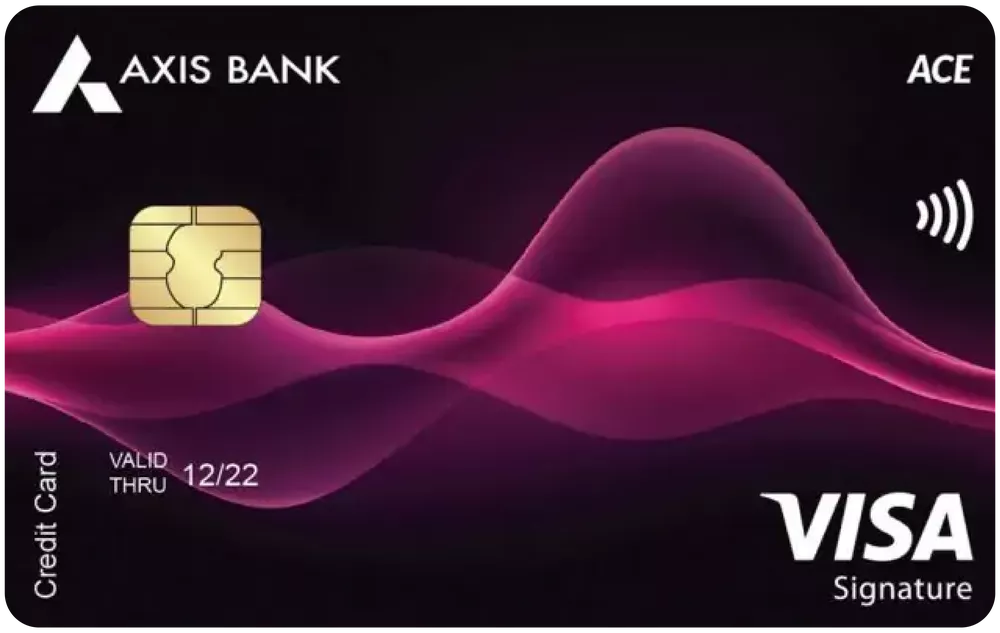
ACE Credit Card
Cashback on utility bills via Google Pay and daily spending
What “premium approval” actually needs
Issuers rarely publish “Magnus needs 780.” In practice premium underwriting looks at:
- CIBIL / bureau score — often 750+ is where many salaried files become competitive (population data from CIBIL’s consumer article — not your personal guarantee).
- Income and job stability — premium cards assume higher take-home pay and cleaner employer risk buckets.
- Existing limits — already holding multiple high lines can help or hurt depending on utilisation.
- Recent enquiries — three applications in a month can block a strong score.
Takeaway: improve the report, not only the number. A 760 score with a 30-day overdue last quarter still fails many premium screens.
The five factors — where to spend your energy
CIBIL’s public materials describe score drivers in plain language (read on CIBIL). For action planning, think in this order:
| Factor | What hurts | Fastest fix you control |
|---|---|---|
| Payment history | Any late card/loan mark | Clear overdue + auto-pay full statement |
| Credit utilisation | Balances near limits | Pay down before statement date; request limit increase only if disciplined |
| Credit age | Closing oldest card | Keep old card open; downgrade fee if needed |
| Credit mix | Only unsecured clutter | Time — add one clean product, not five |
| New enquiries | Many applications | Pause applications 90 days |
Exact weight percentages vary by bureau model — treat tables on random blogs as illustrative, not law.
90-day sprint — week by week
Days 1–7 — Diagnose
- Download free CIBIL report.
- List every overdue, written-off, or settled line — fix data errors via bureau dispute first.
- Note utilisation per card (balance ÷ limit).
Days 8–30 — Stop the bleeding
- Pay minimum due + overdue on every tradeline — premium underwriters hate fresh delinquency most.
- Set auto-debit for full statement amount on active cards.
- Zero new card applications this month.
Days 31–60 — Lower utilisation
- Target under 30% on each card; under 10% on your main card before statement generation if you can.
- Pay down highest-utilisation cards first — that moves the needle faster than spreading ₹5,000 evenly.
- Optional: ask bank for limit increase on a 12+ month clean card — only if you will not spend into it.
Days 61–90 — Build proof, then aim premium
- Run small recurring bills (mobile, OTT) on one card; pay full every cycle.
- Pull CIBIL again — score should stabilise if behaviour changed.
- Shortlist one premium card that matches income; read MITC fee waiver lines before applying.
Mistakes that kill premium applications
- Applying while utilisation is 80%+ — banks see stress even if you “always pay full.”
- Loan settlement shortcuts — “settled” reads worse than “closed” for years.
- Guaranteeing someone else’s loan — their miss becomes your file noise.
- Co-signing without tracking the account.
- Chasing five cards after one rejection — each hard inquiry stacks.
- Paying only minimum while planning an Infinia application — interest cost plus weak behaviour signal.
If your score is under 650, spend six months on entry cards first (companion bands) — premium fees are wasted on a likely decline.
Premium cards to aim for once your file is clean
These are aspirational targets on CardCheck — verify income floors and invite rules on the issuer site.
HDFC Bank Infinia Metal Credit Card
Positioning: top-tier HDFC travel and lifestyle line in our catalogue — high fee, high expectation. Apply only when utilisation is tame and income is documented.
Axis Bank Magnus Credit Card
Positioning: flagship Axis rewards / lounge story — relationship and spend thresholds matter beyond raw CIBIL.
SBI Card PRIME
Positioning: strong mid-premium step — ₹2,999 fee with waiver on ₹3 lakh spend in published benefits; easier bridge than metal invite cards for many salaried users.
HDFC Bank Regalia Gold Credit Card
Positioning: upgrade path below Infinia — useful when score crossed 750 but income is not yet Infinia-grade.
Axis Bank ACE Credit Card
Positioning: not premium — included as the cashback workhorse to build 12 months of perfect payments before you chase Magnus. ₹499 fee, strong Google Pay utility line in published benefits.
Income and documentation — the other half of “approved”
Premium teams ask for salary slips, ITR, or bank statements showing consistent credits. Tips that help real files:
- Salary account with the issuing bank improves odds for that bank’s premium line.
- Avoid frequent job switches in the three months before application if possible.
- Declare all existing cards — hiding limits discovered later is fraud risk.
Use CardCheck’s Eligibility checker after your 90-day cleanup — it filters cards by common income bands so you do not waste a hard inquiry on a product you cannot qualify for.
When “fast” is not realistic
Recent default or settlement: expect months to years, not weeks, before premium issuers reconsider. Thin file (no history): build with ICICI Platinum Chip-class entry products — see First credit card without income proof or compare ₹0 fee cards on Browse cards. Score already 750+ but declined: problem is usually income, employer category, or existing exposure — not another five-point bump.
Still unsure which premium line fits spend? Compare Magnus vs Regalia after your bureau file is clean.
FAQ
- How fast can I raise my CIBIL score for a premium card?
Meaningful moves from high utilisation or data errors can show within one to two billing cycles. Recovering from defaults takes much longer. Plan 90 days of clean behaviour before a premium application — “overnight 100 points” marketing is not how bureau math works.
- What CIBIL score do I need for HDFC Infinia or Axis Magnus?
Banks do not publish fixed numbers. 750+ is often cited in CIBIL’s own consumer statistics as common among approved borrowers — still not a promise. Income, enquiries, and existing limits decide. Check free CIBIL first.
- Will paying minimum due improve my score?
It avoids new late marks, but high revolving balance keeps utilisation high. Premium approvals want full payments and low reported balances — minimum-only is a trap, not a strategy.
- Should I close old cards before applying for premium?
Usually no — closing reduces average age and can raise utilisation on remaining cards. Downgrade annual fee or stop using the card instead of closing if it is your oldest line.
- Does checking CIBIL hurt my score?
A self-check on CIBIL is a soft inquiry. Bank applications are hard inquiries — space them out.
- Which CardCheck tool helps after I improve my score?
Run Eligibility checker, then Compare on Infinia, Magnus, and SBI PRIME before you submit one application.
Cards in this comparison (5)
Infinia Metal Credit Card
Travel and lifestyle benefits
Magnus Credit Card
Travel & Lifestyle
SBI Card Prime
Dining and grocery rewards
Regalia Gold Credit Card
Travel rewards
ACE Credit Card
Cashback on utility bills via Google Pay and daily spending

Vineet Verma
Lead AnalystLead Financial Researcher & Credit Card Analyst at CardCheck
Vineet specializes in Indian retail banking terms, reward point economics, and MITC verification. Every insight is audited against official bank filings.