
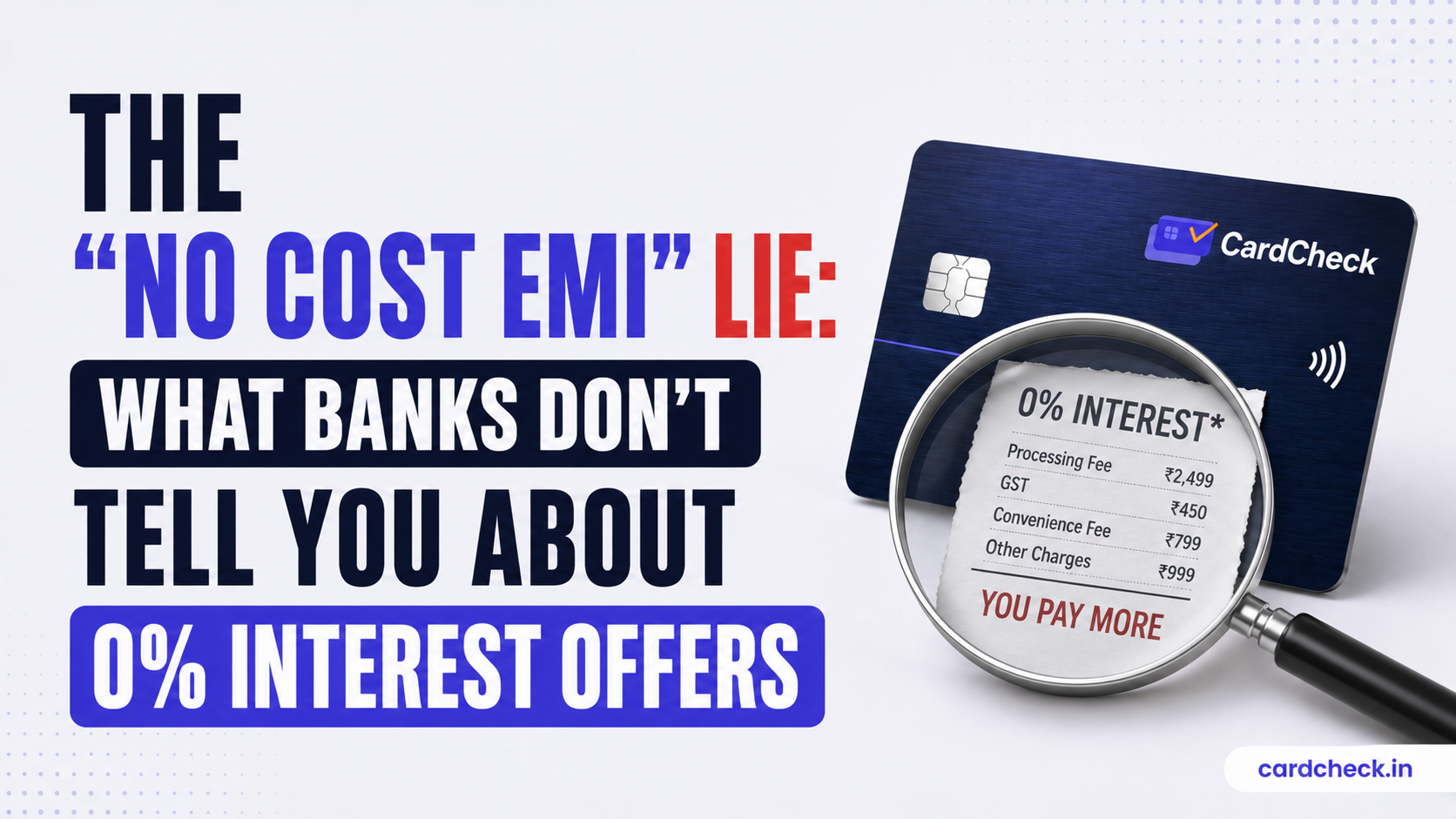
Amazon and Flipkart still flash 0% interest beside EMI tenures. Your bank app nods along. The sticker price divides neatly into months — and your brain files it under free.
It is not free in the way the font implies. Reserve Bank of India rules say issuers must show principal, interest, and any upfront discount that makes the EMI look “no cost” — and must not dress up a loan that still has an interest component as zero-interest marketing (RBI credit card directions).
This piece is the receipt-under-the-magnifying-glass version: what no-cost EMI actually is, the extra rupees that rarely make the banner, and what to check before you tap Pay. Numbers below are illustrative — your MITC booklet and checkout disclosure win.
Cards in this comparison (3)
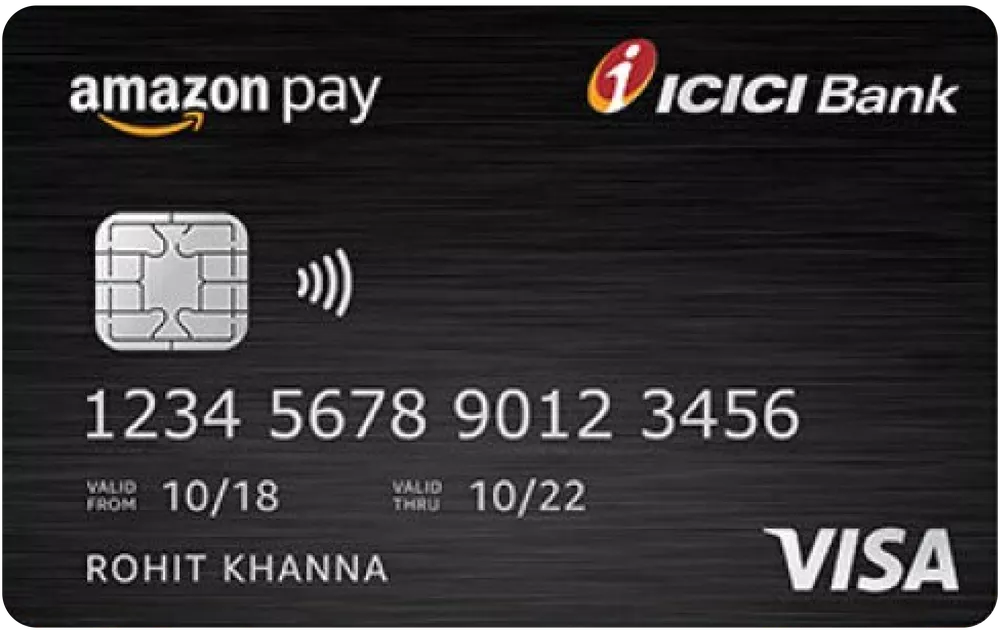

Amazon Pay ICICI Bank Credit Card
Rewards on Amazon Purchases
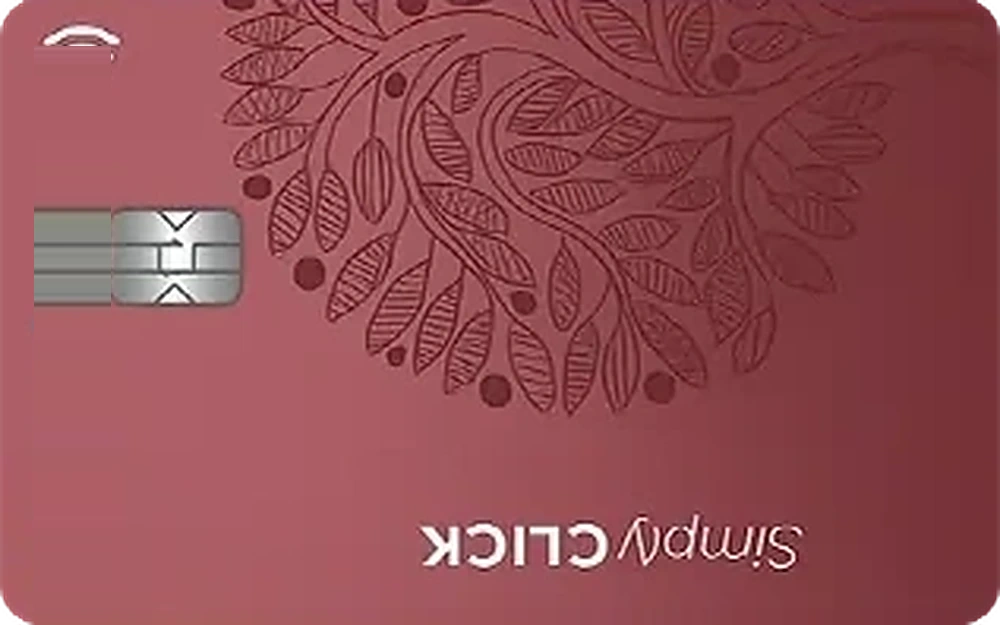

SimplyCLICK SBI Card
Online shoppers — 10X on Amazon, Cleartrip, Lenskart, BookMyShow

HDFC Millennia Credit Card
online shoppers
Why “0% interest” still appears at checkout
The pitch: Pay the same total as the shelf price, just slower.
The mechanics: Someone still funds the gap between “cash today” and “instalments over six months.” That cost is usually hidden in a merchant discount, baked into the listed price, or passed to you as processing fees and tax lines — not waved away by typography.
RBI has long called pure zero-percent card schemes misleading when interest is camouflaged as fees. The newer Master Directions push the same idea for 2026: transparency before conversion, and the same breakdown on your statement.
What RBI requires banks to show you
Before your purchase becomes EMI, issuers are expected to disclose, in plain sight:
- Principal you are repaying
- Interest (even if a brand or merchant subsidises it)
- Upfront discount from merchant or issuer that makes the plan look “no cost”
That trio must also show up on your credit card bill. If marketing says no-cost but the backend still has an interest leg, regulators treat that as camouflage — not a loophole for shoppers.
Consumer RBI credit card FAQs are worth one slow read when you are new to EMI — they frame rights without replacing your bank’s tariff PDF.
The two ways “no cost” is built (simplified)
| Model | What the shopper sees | Who pays the finance cost | What to verify |
|---|---|---|---|
| Upfront discount / subvention | Listed price matches EMI total; cash buyers may get a lower sticker elsewhere | Merchant or brand funds interest as a discount you never see | Compare cash vs EMI SKU on the same site |
| Price padding | EMI total looks “normal” but cash price on another channel is lower | You pay via higher principal or bundled “fees” | Hunt processing / convenience lines at sanction |
Neither model is automatically evil. Both can still cost you GST on fees, foregone bank rewards, and blocked credit limit — topics banks rarely put in the same font size as 0%.
Hidden charges banks rarely highlight upfront
Processing / convenience fee: Many issuers charge a flat or percentage fee when the purchase converts to EMI. 18% GST often applies on that fee line — read the sanction screen, not the product thumbnail.
GST on the interest component: Even when interest is subsidised so your EMI total matches the tag price, tax rules can still put GST on the interest portion in your schedule. You may pay it even when the interest row feels “invisible.”
Foreclosure / prepayment: Closing EMI early can trigger a percentage of outstanding principal plus GST — “no cost” does not mean “exit free.”
Foregone cash discount: The same phone may sit at ₹46,000–48,000 on a cash offer while the no-cost EMI path sticks to ₹50,000 — that gap is a real cost, just not labelled “interest.”
Lost rewards: Most cashback and points programmes exclude EMI from earning — we cover that next with cards people actually hold.
Illustrative maths: ₹50,000 phone, six months
Scenario (example only): ₹50,000 item, 6-month no-cost EMI, subsidised interest so instalments are ₹8,333/month, plus issuer charges below.
| Line item | Illustrative amount | Notes |
|---|---|---|
| EMI principal + subsidised interest | ₹50,000 total | Matches tag price — not the whole story |
| Processing fee (say ₹199–500 range) | ₹199–500 | Check your MITC — banks differ |
| GST on processing (18%) | ~₹36–90 on ₹199–500 fee | Added to cost, not always inside EMI headline |
| GST on interest leg (if applicable) | Varies | Depends on disclosure; read amortisation |
| Foregone 5% cashback (if EMI excluded) | ~₹2,500 on ₹50k online spend | Only if you would have paid full upfront on a rewards card |
Rough band: Many shoppers land ₹2,000–4,500+ worse off than cash + rewards, even when the banner screams 0% — not because EMI is always bad, but because headline math ignores side costs.
Run your own basket through CardCheck’s Rewards Calculator with EMI toggled off vs on before you romanticise the tenure dropdown.
What they do not put beside the 0% badge: limit block
On many cards, the full purchase amount blocks your credit limit even though you repay monthly. A ₹50,000 EMI on a ₹1.5 lakh limit can push utilisation past comfort zones until principal frees up each month.
That matters if you planned travel, rent on card, or another big swipe in the same billing cycle — available limit in the app is the truth, not the EMI font.
Related: 7 credit card myths (utilisation and CIBIL) · deeper EMI mechanics in no-cost EMI explained.
Rewards that vanish when EMI is selected
Issuer MITC and reward FAQs commonly list EMI beside fuel, rent, wallets, and government spends — meaning no points / no cashback on that transaction even when the product page still advertises 5% back on the category.
Three cards Indians compare for online spend — check exclusions on each issuer page, not this article:
Amazon Pay ICICI Bank Credit Card
Strong Amazon.in cashback story on full swipe — many co-brand programmes skip EMI on the same cart. Model Amazon-heavy spend with and without EMI in the calculator.
SBI SimplyCLICK Credit Card
Online partner accelerators are attractive on straight purchases — EMI conversions often sit in the no rewards bucket on SBI Card’s published exclusion lists.
HDFC Bank Millennia Credit Card
SmartBuy / partner cashback is a reason people hold Millennia — again, verify whether your EMI path still earns before you assume headline rates.
Before you tap Pay — 60-second truth test
- Screenshot cash price vs EMI price for the same SKU (colour, warranty, seller).
- Open the EMI sanction / amortisation popup — find principal, interest, discount lines RBI expects.
- Note processing fee + GST — add them to total cost mentally.
- Search your MITC PDF for EMI in the rewards exclusion section.
- Check available limit after block if another big charge is due this month.
- Compare total outflow to paying upfront on a card that does earn on that merchant category.
If step 6 wins by a wide margin, no-cost EMI is convenience — not a bargain.
When no-cost EMI is still defensible
- You verified fee lines are thin and cash price is not cheaper on the same platform.
- You need liquidity smoothing for a planned replacement and will not revolve other card debt.
- You accept zero rewards on that ticket and already modelled it in the calculator.
Skip it when you are already in the minimum due trap on another balance — EMI does not fix discipline on unpaid revolving amounts.
Disclaimer: India education only. Fees, GST treatment, and foreclosure slabs change — issuer MITC + live checkout beat any blog.
FAQ
- Is no-cost EMI really 0% interest in India?
Marketing often says yes; regulators say disclose honestly. RBI directions require showing interest and discounts — EMI with an interest leg must not be camouflaged as zero-interest (directions). You may still pay fees, GST, and opportunity cost on rewards.
- Why do I pay GST if interest is “free”?
Indirect tax can apply on taxable fee and interest components in the EMI schedule even when a merchant subvention makes your instalment total match the tag price. The sanction screen and statement should show the breakdown.
- Do I earn cashback on no-cost EMI purchases?
Often no. Many Indian cards exclude EMI transactions from cashback or points — see your MITC. That foregone earn can exceed a small processing fee.
- Does EMI block my full credit limit?
Frequently yes until principal amortises — behaviour varies by issuer. Check available limit in the app right after conversion.
- Can I prepay EMI without penalty?
Not always. Many programmes charge foreclosure fees (percentage of outstanding + GST). Read that paragraph before you tick the checkbox.
- How is this different from your other no-cost EMI article?
This piece focuses on the “0% lie” and hidden rupee costs. For reward exclusions, GST detail, and a longer checklist, see no-cost EMI explained.
Cards in this comparison (3)
Amazon Pay ICICI Bank Credit Card
Rewards on Amazon Purchases
SimplyCLICK SBI Card
Online shoppers — 10X on Amazon, Cleartrip, Lenskart, BookMyShow
HDFC Millennia Credit Card
online shoppers

Vineet Verma
Lead AnalystLead Financial Researcher & Credit Card Analyst at CardCheck
Vineet specializes in Indian retail banking terms, reward point economics, and MITC verification. Every insight is audited against official bank filings.